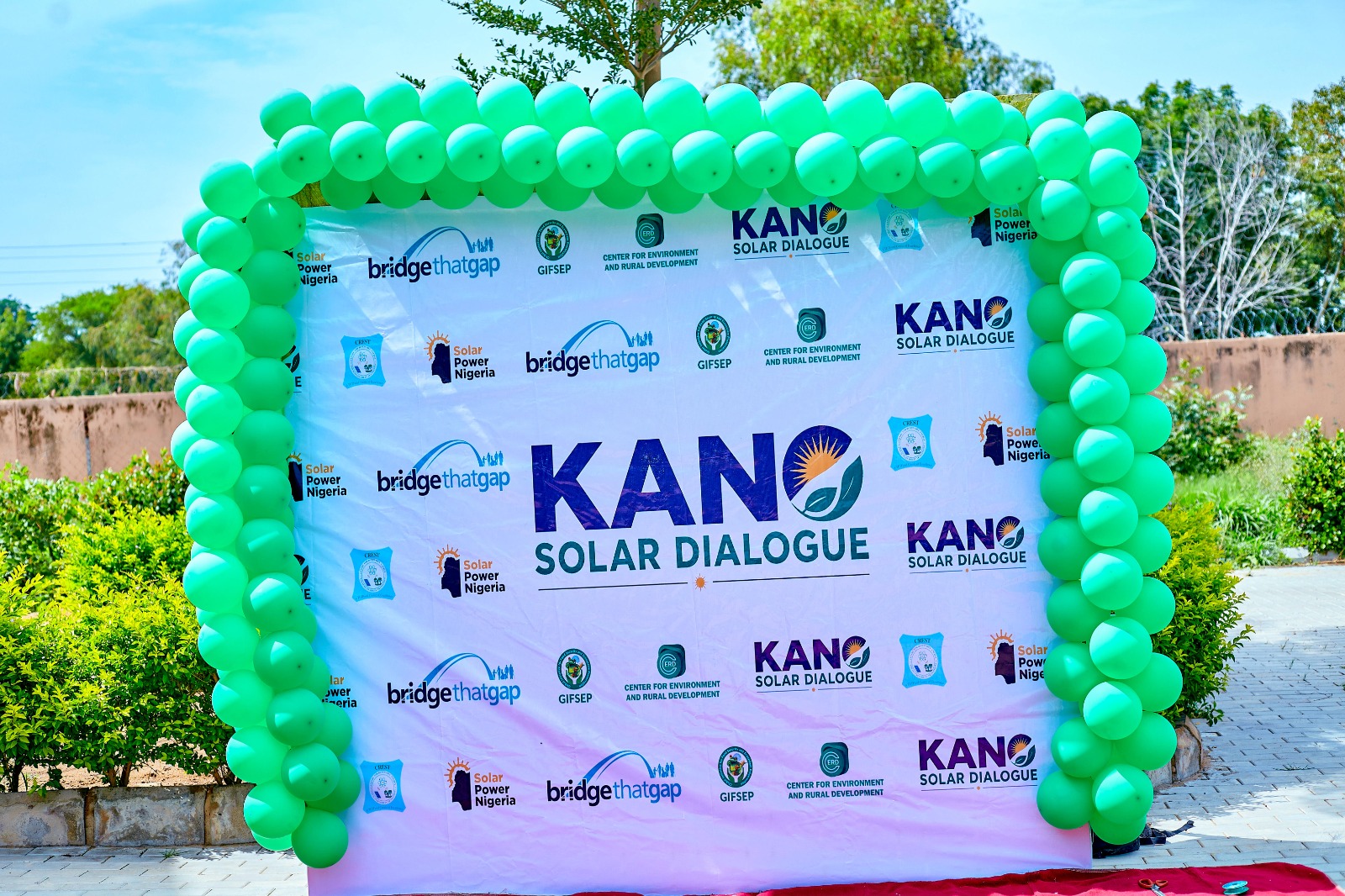
Stakeholders have called on the Federal Government to develop a National Renewable Energy Industrialization Roadmap to boost Nigeria’s clean energy sector, support local manufacturing, and expand access to affordable solar energy. The call was made on Wednesday at the Kano Solar Dialogue 2026 held at Bayero University Kano.
The Dialogue was organized by the Centre for Renewable Energy and Sustainability Transition, CREST, and the Global Initiative for Food Security and Ecosystem Preservation, GIFSEP, under the Solar Power Nigeria Campaign. It brought together government, academia, private sector, financial institutions, civil society, and renewable energy industry players.
Discussions focused on Nigeria’s growing solar energy sector, opportunities for local manufacturing, renewable energy investment, quality standards, and the Federal Government’s proposed policy to restrict solar panel imports. Participants included representatives of KEDCO, NESREA, the Federal Ministry of Science, Innovation and Technology, and Kano State Government.
In his keynote, GIFSEP Executive Director Dr. Michael Terungwa David described Nigeria as facing the paradox of abundant energy resources and widespread energy poverty. Citing the World Bank 2025 report, he said about 86.8 million Nigerians still lack electricity, forcing many households and businesses to rely on costly petrol and diesel generators.
Dr. David said the recent growth in solar adoption shows renewable energy is now a practical solution for homes, businesses, schools, and hospitals. He noted that solar offers Nigeria a real opportunity to bridge the electricity access gap with clean, affordable, and reliable power.
However, he cautioned against an immediate blanket ban on imported solar panels. He warned that restricting imports now could slow renewable energy adoption, increase costs, and worsen energy poverty. He said Nigeria is not yet ready for such a ban and should instead pursue a phased industrialization strategy.
Dr. David recommended incentives for local manufacturing, affordable financing, investment in technical training and research, stronger quality standards, and gradual import substitution. He also highlighted opportunities in the Electricity Act 2023, which allows states to play a bigger role in decentralized renewable energy development.
At the end of the Dialogue, stakeholders agreed Nigeria needs a National Renewable Energy Industrialization Roadmap. They called for more investment in technical education, innovation, tax waivers, and support for domestic production. They also urged that any future restrictions on solar imports should only come after Nigeria can meet demand locally.

Abuja’s number one hit music and talk radio station. Broadcasting 24/7 on 99.9FM across the Federal Capital Territory and streaming live worldwide.
© KissFM 99.9 All rights reserved.