ABUJA, Nigeria
The Federal Government has reaffirmed its commitment to affordable, renewable energy, saying access to clean energy is critical for households, businesses and Nigeria’s climate response.
Representing the Federal Government, the Special Assistant to the President on Climate Energy, Comrade Yussuf Kelani, said finding solutions to affordable energy through renewable sources is very important because energy affects homes and businesses.
Kelani said Nigeria’s Energy Transition Plan is germane and must move from framework to action. He said clean energy is an essential component of climate response and a key driver for economic growth.
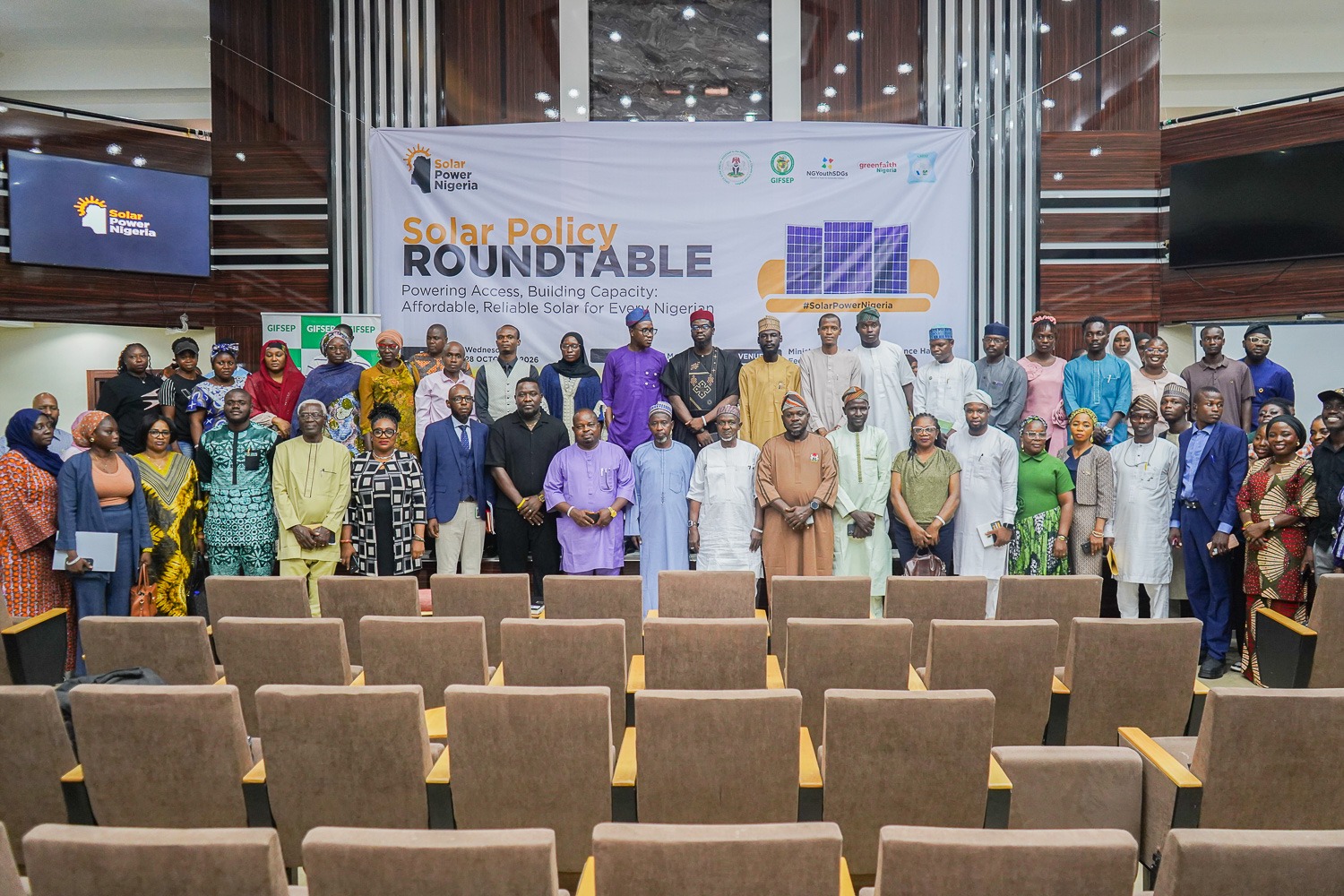
He spoke at the Solar Policy Roundtable held on March 28, 2026, in Abuja, where stakeholders discussed how to strengthen Nigeria’s solar photovoltaic sector.
The roundtable was convened by Dr. Michael David, Executive Director of the Global Initiative for Food Security and Ecosystem Preservation and Co-convener of the Solar Power Nigeria Campaign.
Why Dr. Michael says solar is urgent
Dr. Michael, who set the tone for the discussion, said millions of Nigerians still lack reliable electricity, forcing homes, hospitals, schools and small businesses to spend heavily on petrol and diesel generators.
He said Nigeria’s solar market is expanding fast. According to National Bureau of Statistics trade data, Nigeria imported about 2.9 million solar panels in 2025 valued at N435.52 billion, making the country Africa’s second largest importer of solar panels.
“This figure shows the scale of demand and the enormous opportunity before us,” Dr. Michael said. “But market growth alone is not enough. We must translate rising demand into local jobs, technical expertise, industrial development and sustainable access to clean energy.”
No to premature ban
Dr. Michael commended the Minister of Innovation, Science and Technology, Dr. Kingsley Tochukwu Udeh, for stating that Nigeria will not ban solar panel imports before developing sufficient domestic manufacturing capacity.
“You can’t ban importation of solar panels if you do not have manufacturing capabilities in the country,” the minister had said.
Dr. Michael said a premature ban would increase prices, slow adoption and hurt households and businesses that need reliable power urgently.
He said any future restriction must be sequenced against verified local production capacity, competitive pricing and effective quality certification.
Nigeria currently has an estimated 350 megawatts of operational module assembly capacity from firms including LPV Technologies, Auxano Solar and NASENI, but the activity is still mainly assembly of imported cells, glass and other components, not full manufacturing.
What must change
Dr. Michael identified three priority areas to strengthen the solar ecosystem.
First is skills development. He called for a national certification pathway for solar technicians, retraining of generator technicians and mandatory certification for publicly funded solar installations.
Second is local manufacturing and assembly. He urged predictable policies, access to finance, incentives and progressive local-content requirements that grow with capacity. He said public procurement should reward quality and genuine local value, not just volume.
Third is quality assurance. He called for better coordination among the Standards Organisation of Nigeria, the Nigerian Electricity Management Services Agency and the Nigerian Electricity Regulatory Commission to enforce standards, set up testing labs and stop substandard and counterfeit panels.
“Who is importing the equipment? Does it meet standards? Are installers trained? Who ensures consumer protection?” Dr. Michael asked.
Roadmap for localisation
The policy brief presented at the roundtable warned that an immediate blanket ban on imported panels would be a “protectionist shock.” It would cause a 15 to 25 per cent price surge, add at least N80,000 to the cost of a typical four-panel home system, and threaten jobs in the 90 per cent import-dependent installation sector.
Instead, the brief recommended a phased, evidence-based localisation strategy over three to five years.
Under the plan, regulated imports would continue while government grants Pioneer Status tax holidays to certified manufacturers, removes VAT and duty on raw materials like solar cells and manufacturing machines, and imposes a modest 10 to 20 per cent tariff on finished imported panels to bridge the N14,000 to N20,000 per-panel price gap.
It also recommends 30 to 50 per cent mandatory local content quotas for government electrification projects, dedicated power feeders for solar industrial zones, single-digit concessional financing from the Bank of Industry and Central Bank, and strict enforcement of international quality standards.
Dr. Michael said Nigeria has the raw materials, silica sand, lithium, copper, aluminum but lacks processing infrastructure, reliable industrial power and testing facilities.
“The cost of inaction is clear: continued dependence on expensive fuel, lost industrial opportunities, and millions without reliable power,” he said.
He urged government, private sector and development partners to work together to build a solar sector that delivers affordable electricity, skilled Nigerian workers, competitive local factories and quality-assured products.




Abuja’s number one hit music and talk radio station. Broadcasting 24/7 on 99.9FM across the Federal Capital Territory and streaming live worldwide.
© KissFM 99.9 All rights reserved.