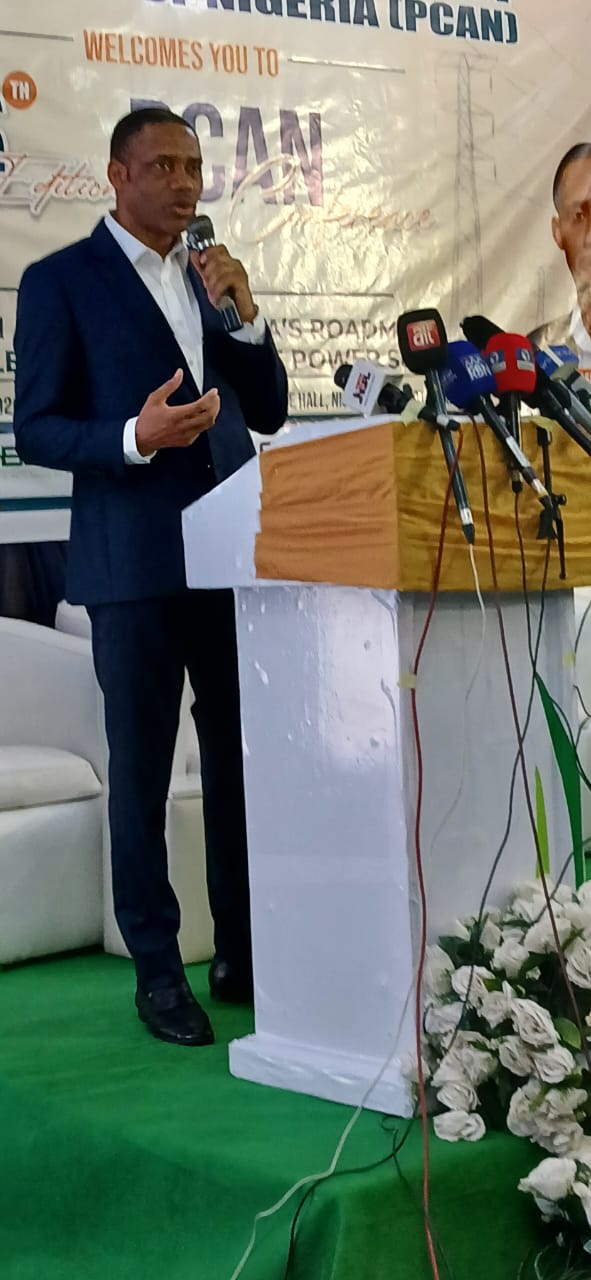
ABUJA, NIGERIA – Kenny Anuwe, Managing Director and Chief Executive Officer of FGN Power Company Limited, said Nigeria’s Presidential Power Initiative (PPI) is on course to deliver an additional 5,540 megawatts (MW) of electricity wheeling capacity to the national grid, a development aimed at supporting the country’s ambition of building a $1 trillion economy.
Speaking at the 6th Annual Conference of Power Correspondents Association of Nigeria, PCAN in Abuja, Anuwe said the initiative represents one of Nigeria’s most comprehensive power infrastructure programmes, combining transmission, distribution and financing interventions designed to improve electricity reliability and expand access to power for businesses and households.
The Presidential Power Initiative, being executed by FGN Power Company on behalf of the Federal Government, seeks to expand transmission and distribution capacity, unlock stranded generation and improve the performance of the national grid through coordinated infrastructure investments and strategic partnerships. The programme’s target is to add 5,540MW of wheeling capacity by 2028.
According to Anuwe, the programme has already achieved significant milestones through its pilot phase, which delivered 1,080MW of additional transmission wheeling capacity through the installation of 10 power transformers and 10 mobile substations across key locations nationwide. The pilot phase was supported by €60.4 million in financing and included installations in Abuja, Lagos, Kano, Oyo, Ogun, Edo, Delta, Kogi, Niger and Yobe states.
The next phase of implementation involves five major substations being delivered by Siemens Energy. Located in Abeokuta, Ayede, Offa, Onitsha and Sokoto, the facilities are expected to contribute an additional 984MW of transmission capacity upon completion. Implementation is currently underway, with counterpart funding already provided by the Federal Government.
FGN Power is also advancing a transmission lines programme covering 606.5 kilometres of new high-voltage infrastructure, comprising 399.5 kilometres of 132kV lines and 207 kilometres of 330kV lines. The project is expected to provide cumulative throughput capacity of 7,140MW and strengthen power delivery to critical economic and industrial centres.
Beyond ongoing projects, the company has outlined a pipeline expected to add 3,376MW of further capacity. The projects include the second batch of substation upgrades as well as special interventions at Epe and Omotosho, alongside strategic grid reinforcement initiatives.
The programme is supported through a financing structure under which 85% of project funding is expected from export credit agencies and development finance institutions, while the Federal Government provides 15% counterpart funding. Financing partners include Sinosure, China Exim Bank, KfW IPEX-Bank, Commerzbank, Bpifrance, Standard Chartered and Deutsche Bank.
Anuwe said investments in transmission infrastructure alone would not be sufficient to improve electricity supply, stressing that distribution upgrades are equally critical to ensuring that additional power reaches homes, businesses and industries. Distribution projects are therefore being implemented across multiple electricity distribution companies through partnerships with CMEC, Elsewedy Electric, Power China, CCECC and TBEA.
FGN Power estimates that the initiative could increase the number of hours of reliable electricity supply by approximately 60%, support more than 2,000 industries, benefit roughly 500,000 micro, small and medium-sized enterprises, and improve electricity access for more than 116 million Nigerians within its coverage footprint. The programme is also expected to create over 10,000 direct jobs and stimulate substantial economic activity through investments estimated at ₦569 billion.
Addressing the conference theme, “Nigeria’s Roadmap to Reliable and Affordable Power upply for a $1 Trillion Economy,” Anuwe said the country’s growth ambitions would require bankable and scalable electricity investment models capable of attracting both public and private capital while ensuring long-term commercial sustainability.
He added that the successful delivery of the initiative would depend on timely financing approvals, right-of-way access, environmental and social compliance, and close coordination among government agencies, financiers and implementation partners.
FGN Power’s roadmap targets completion of key priority transmission projects in 2027, completion of the transmission lines programme by 2028 and achievement of the full 5,540MW additional wheeling-capacity objective by 2029.
FGN Power Company Limited is the special purpose vehicle established by the Federal Government of Nigeria to coordinate and implement the Presidential Power Initiative, a nationwide programme aimed at modernising and expanding Nigeria’s electricity transmission and distribution infrastructure.


Abuja’s number one hit music and talk radio station. Broadcasting 24/7 on 99.9FM across the Federal Capital Territory and streaming live worldwide.
© KissFM 99.9 All rights reserved.