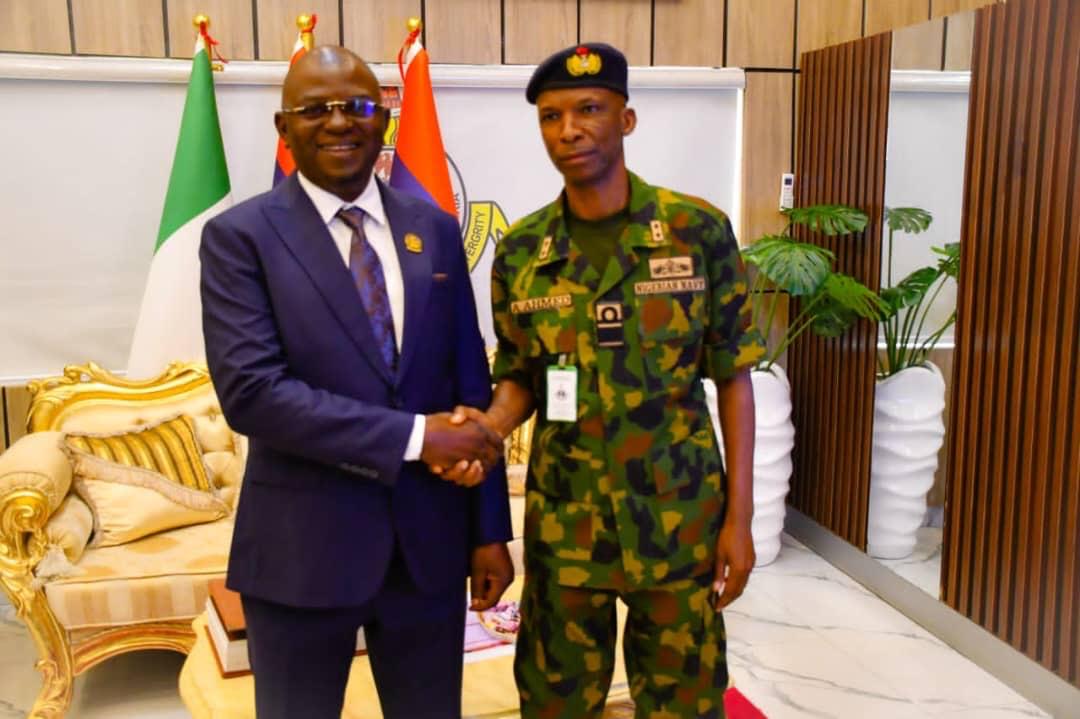
ABUJA — The Minister of Water Resources and Sanitation, Professor Joseph Terlumun Utsev, says water security should be built into Nigeria’s national security framework.
Speaking on Monday at the National Defence College in Abuja, the minister said access to safe water and sanitation is fundamental to public health, food security, economic stability and national resilience.
Professor Utsev delivered a lecture titled _“Water Resources Management and Sanitation as Catalysts for Sustainable National Development and Security in Nigeria”_. He said Nigeria must stop treating water as only a development issue and recognise it as a strategic security priority.
The minister warned that water insecurity, poor sanitation, flooding, drought and climate change can trigger health emergencies, displacement and conflicts over resources. He said these challenges undermine livelihoods and increase vulnerability to climate shocks.
Professor Utsev also spoke on the role of River Basin Development Authorities in irrigation, agriculture, fisheries, rural water supply, flood control and job creation.
On food security, he said irrigation is critical because rainfall patterns are becoming less predictable. He said about 154,000 hectares of irrigable land are currently being used by more than 1.6 million farmers, and that government is working to expand coverage.
The minister cited the 2026 Annual Flood Outlook, which identified 1,249 communities in 176 local government areas across 30 states and the Federal Capital Territory as high flood-risk areas.
He called for stronger coordination between the water, agriculture, health, environment and security sectors. He also urged increased investment, better regulation, climate-resilient infrastructure and greater community involvement.
Professor Utsev said the ministry is developing a National Water Compact for 2026 to 2030. He said the plan is built around three pillars: Water for People, Water for Food and Water for the Planet, covering safe water and sanitation, irrigation and food security, and climate resilience.
He added that the compact is being developed with federal and state governments, security agencies, river basin authorities, traditional and religious institutions, the private sector and civil society.
The minister also stressed the need for water diplomacy, noting that Nigeria shares major water resources with neighbouring countries.
He listed five priorities to strengthen water security: integrating water into national security planning, improving government coordination, increasing investment, building climate resilience and water intelligence, and developing the capacity of women and young people.
The Commandant of the National Defence College, Rear Admiral Abdullahi Ahmed, responded to the lecture. He said flooding, drought and resource-based conflicts are major security concerns, and called for better use of Nigeria’s freshwater resources and stronger regional cooperation.
The minister was accompanied by senior officials of the ministry. Members of faculty at the National Defence College attended the lecture.

Abuja’s number one hit music and talk radio station. Broadcasting 24/7 on 99.9FM across the Federal Capital Territory and streaming live worldwide.
© KissFM 99.9 All rights reserved.