For as long as most Nigerians can remember, conversations about the sugar industry have been about what is wrong with it.
Nigeria imports almost all the sugar it consumes. Plants have been launched and re-launched. Targets have come and gone.
That narrative may be changing.
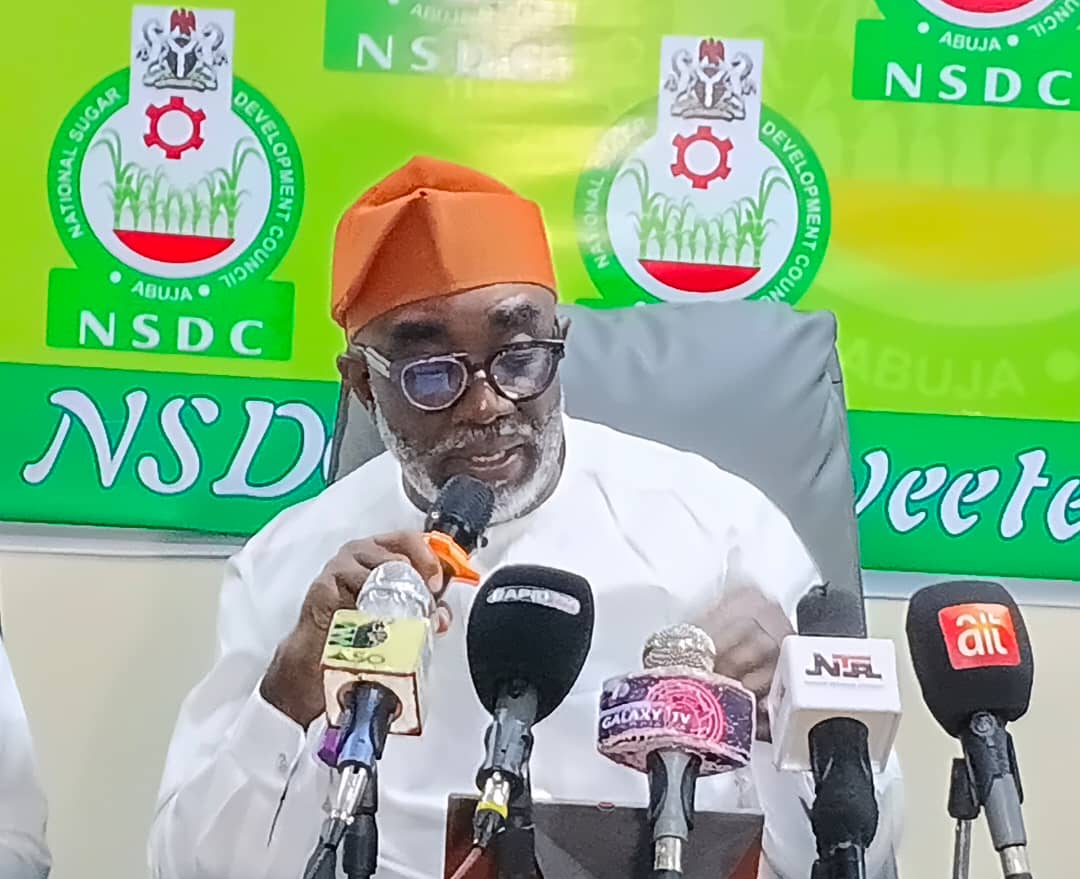
The National Sugar Development Council, NSDC, on Friday said diagnosis of the sector is over and execution of a revised plan has started.
The plan, officials said, will take Nigeria from near-total dependence on imported raw sugar to self-sufficiency of over 2 million tons.
Speaking at a press briefing in Abuja, the Executive Secretary of the council said the plan matters to every Nigerian, not just the sugar industry.
When Nigeria grows and processes its own sugar cane, he said, four national priorities move forward together.
First is foreign exchange. Once fully built, producing sugar and fuel ethanol locally will save Nigeria about 2.1 billion dollars every year.
Second is jobs. The Backward Integration Program will create about 110,000 direct and indirect jobs and touch more than one million livelihoods across the value chain.
Third is rural economy. Records from sugar estates worldwide show host community economies can more than double within 10 years.
Fourth is climate. The program will avoid about 2 million tons of greenhouse gas emissions yearly, equivalent to taking 400,000 cars off the road.
“This is not a sugar story. It’s a foreign exchange story, it’s a job story, and it’s a rural development story,” he said.
Nigeria currently consumes 1.8 million tons of sugar a year. More than 97 percent is refined from imported raw sugar. Last season, local mills produced only about 27,000 metric tons.
The council identified four reasons for the failure – poor economics that favored importation, lack of accountability for missed investment commitments, inability to attract finance, and weak farming practices.
He said forex reforms by President Bola Tinubu have changed the economics, as new estates are designed to earn from sugar, power and ethanol.
He said estate performance is now verified on the ground and by satellite, and government is putting investment commitments on firmer footing.
He said NSDC will now work only with credible promoters with secured land and bankable feasibility studies. The Nigeria Sugar Institute has been rebuilt to supply certified seed cane, new varieties and trained manpower.
The execution rests on three focus areas.
The first is optimizing existing mills through an Outgrower Development Program targeting 11,000 hectares of farmer-grown cane to produce 880,000 tons of cane yearly. About 7,000 hectares have been identified in Kwara, Niger and Adamawa states, with 1,320 hectares to go under cane by next year under off-take agreements.
The move, he said, will raise output to 100,000 metric tons – four times last year’s production – with cane ready in 12 to 18 months.
The second is accelerating three incumbent operators targeting 1.2 million metric tons, about two-thirds of national demand, from 107,000 hectares and 73,000 tons per day crushing capacity. About 85 percent of the land is already in place.
The third is 10 new greenfield projects across eight states – Niger, Kwara, Oyo, Kaduna, Jigawa, Bauchi, Nasarawa and Adamawa – covering over 140,000 hectares with 55,000 tons per day factory capacity to deliver 835,000 metric tons.
Together, the 13 projects will take Nigeria past 2 million tons. He said Nigeria has validated 1.2 million hectares suitable for sugar against 250,000 hectares needed.
He said every site is being taken to bankable status with independent technical reviews by a world-renowned firm.
Inside NSDC, he said, every core process is being redesigned using Lean Six Sigma, automation, digitization and Artificial Intelligence.
The council has established 222 hectares of seed cane farms in Kwara and Kano with additional 122 hectares planned to deliver 18,000 tons of certified seed cane for the 2026/2027 season.
He said adoption of bud chip technology has cut nursery requirement for a 20,000-hectare estate from 6,000 hectares to 260 hectares, with 30 million seedlings capacity already built.
On skills, he said 95 professionals were trained this year, including 80 certified in basic sugarcane agronomy and 15 graduate trainees in field operations.
On financing, the entire program will cost 7.1 billion dollars over 10 years. About 5 billion dollars, or 70 percent, will come from long-term development capital – 3 billion dollars from export credit agencies, 1.75 billion dollars from other Development Finance Institutions and 250 million dollars from local sources.
The balance of 2.1 billion dollars will come from promoters’ balance sheets.
He said commercial loans at 28 percent cannot finance sugar estates.
He disclosed a 1 billion dollars Engineering, Procurement, Construction and Finance agreement signed with Chinese group SINOMACH, similar frameworks with Chinese and Indian entities, and a 10 billion naira Sugar Project Acceleration Fund with Bank of Industry for feasibility studies.
“Delivery has started. The diagnosis is behind us. You will judge us by results – hectares, tons of sugar, how assets are financed,” he said.


Abuja’s number one hit music and talk radio station. Broadcasting 24/7 on 99.9FM across the Federal Capital Territory and streaming live worldwide.
© KissFM 99.9 All rights reserved.