When we talk about the consequences of illicit financial flow,
It is about the mother who cannot afford hospital bills. The graduate who cannot find a job. The trader who pays tax but still drives on a bad road. The student who learns in a classroom without chairs.
Illicit financial flows affect all of them, even if they have never heard the name.
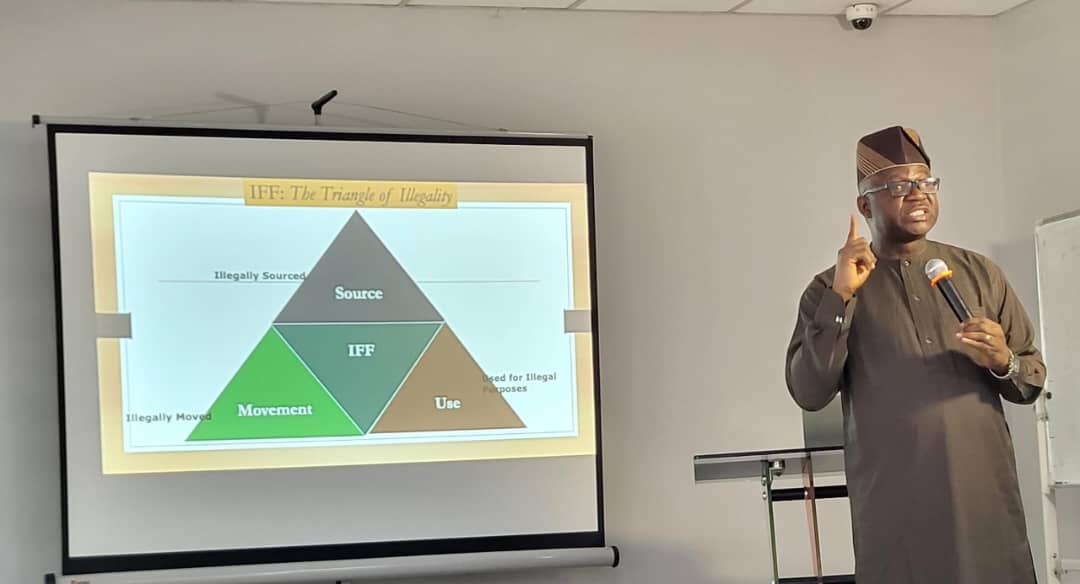
In simple terms, illicit financial flows are money that is earned illegally, moved illegally, or used illegally across borders. It is money that should work for Nigeria, but instead disappears.
Speaking at a stakeholder engagement in Abuja, financial crime investigator and forensic expert Adedayo Adeyinka Kayode warned that Nigeria cannot continue to lose this money and still expect development.
He said Nigeria needs stronger compliance, better transparency, tougher enforcement, and action from all Nigerians, not just government agencies.
What Is Really Happening To Nigeria’s Money?
The money does not disappear by magic. It leaves through familiar channels.
Sometimes, a company declares goods at a false price to pay less tax. This is called trade misinvoicing.
Sometimes, a multinational company shifts its profit to another country where tax is low. This is called profit shifting.
Sometimes, a public official takes a bribe or embezzles funds, then hides the money behind a company whose real owner is unknown.
Sometimes, criminals move money from drug trafficking, human trafficking, cyber fraud, oil theft, and illegal bunkering, and then launder it to make it look clean.
Globally, more than 60 percent of illicit flows come from commercial and tax-related activities, not corruption alone. That means the biggest leak is not just in government offices. It is also in business, in trade, and in the financial system.
Africa loses more through illicit flows than it receives in foreign aid. Nigeria, with its heavy dependence on oil, large informal economy, and weak data sharing among agencies, is one of the most affected.
What Does It Cost Ordinary Nigerians?
The cost is visible in everyday life.
When government loses revenue, it borrows more. When it borrows more, it has less to spend on education, healthcare, and infrastructure.
When companies avoid tax, honest businesses suffer. They pay their full tax, yet they compete with those who cheat. The market becomes unfair.
When money is taken out of the country, jobs disappear with it. Money that should have built a factory in Lagos, a farm in Kaduna, or a tech company in Enugu ends up building wealth somewhere else.
When public trust falls, people stop believing that the system can work for them. Inequality grows. Poverty deepens. Insecurity rises.
Kayode said the economic consequences are extensive: revenue losses, reduced fiscal capacity, capital flight, weaker investment, and distorted competition. Illicit flows can also fund organised crime and damage Nigeria’s reputation.
In short, Nigerians are paying the price for money they never saw.
Why The System Keeps Failing
Kayode pointed to weaknesses that Nigerians see every day but often ignore.
Many organisations do not separate duties properly. One person approves, pays, and reports, with no one checking.
Many businesses do not properly check their customers and suppliers. They do not ask who truly owns the company they are dealing with.
Procurement is often opaque. Ownership is hidden. Agencies do not share information.
These weaknesses make it easy for illegal money to move.
Nigeria has laws to fight this. There is the Money Laundering (Prevention and Prohibition) Act 2022, the Proceeds of Crime (Recovery and Management) Act 2022, and the Nigerian Financial Intelligence Unit Act 2018. There are institutions like the EFCC, ICPC, NFIU, CBN, CAC, SEC, NRS, and Customs.
There is also a Beneficial Ownership Register, transfer pricing regulations, and the Nigeria Tax Act 2025.
But Kayode said the key challenge is implementation. Laws do not work if people do not follow them.
What Must Nigerians Do?
This is where the call for action begins. The fight against illicit flows is not for government alone. It is a shared national responsibility.
1. Citizens must demand accountability.
Nigerians should ask where public money goes. They should ask how contracts are awarded, how much was budgeted, and what was delivered. They should follow up on projects in their communities. Silence allows leakage to continue.
2. Businesses must comply.
Business owners must keep proper records, declare true values, pay correct taxes, and know who they do business with. Strong Know Your Customer and beneficial ownership checks are not just for banks. They are for every business.
Companies must separate duties, carry out regular audits, monitor transactions, and train staff to spot suspicious activity.
3. Workers must speak up.
Employees who see fraud, false declarations, or suspicious transactions should be protected when they report. Kayode called for stronger whistleblower protections. Nigerians must see reporting wrongdoing as patriotism, not betrayal.
4. Communities must reject the culture of unexplained wealth.
When a person with no visible business suddenly displays massive wealth, Nigerians should ask questions instead of celebrating it. Unexplained wealth is often a sign of illicit flows.
5. Professionals must refuse to be enablers.
Lawyers, accountants, bankers, and real estate agents must not help hide ownership or move suspicious money. Their role is to protect integrity, not to cover illegality.
6. Government must move from announcements to results.
Kayode said the national response must be built on five pillars: prevention, detection, enforcement, recovery, and accountability.
Prevention means stopping the leak before it happens. Detection means finding suspicious transactions early. Enforcement means investigating and prosecuting offenders. Recovery means bringing back stolen assets lawfully. Accountability means showing Nigerians what was recovered and what changed.
Nigerians must measure government not by how many policies are announced, but by how many cases are resolved, how much is recovered, and how services improve.
The Choice Before Nigeria
Experts at the engagement agreed that commercial tax abuse remains the biggest driver of illicit flows. If Nigeria does not fix it, it will continue to lose resources needed for development.
But Nigeria has a choice.
It can continue to watch money leave quietly, while poverty grows and infrastructure decays. Or it can strengthen compliance, improve transparency, enforce its laws, and insist on accountability at every level.
As Kayode put it: “The response must combine prevention, detection, enforcement, recovery and accountability. Financial integrity is a shared national responsibility.”
That means the market woman, the student, the business owner, the civil servant, the banker, and the politicians all have a role.
Nigeria’s wealth must work for Nigerians. To make that happen, Nigerians must act.


Abuja’s number one hit music and talk radio station. Broadcasting 24/7 on 99.9FM across the Federal Capital Territory and streaming live worldwide.
© KissFM 99.9 All rights reserved.