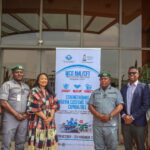
ABUJA, Nigeria – The National Insurance Commission and the Federal Fire Service have strengthened collaboration to advance public safety and enforce compulsory insurance in Nigeria, inaugurating a technical committee to implement key provisions of the Nigerian Insurance Industry Reform Act 2025.
The committee, comprising representatives of NAICOM, the Federal Fire Service and the Nigerian Insurers Association, has six weeks to submit recommendations for the operationalisation of the Fire Services Maintenance Fund.
The decision was reached at a high-level meeting in Abuja attended by the Commissioner for Insurance, Olusegun Ayo Omosehin; the Comptroller-General of the Federal Fire Service, Samuel Adeyemi Olumode; and the Chairman of the Nigerian Insurers Association, Ebelechukwu Nwachukwu.
Omosehin said the engagement was a critical step toward translating the new law into practical measures that will benefit Nigerians. He thanked President Bola Tinubu for his support for reforms in the insurance sector.
He cited Section 76 of the Act, which makes it mandatory for every public building to be insured against collapse, fire, earthquake, storms, floods and other hazards prescribed by the commission.
Under the Act, insurers underwriting public building policies must remit 0.25% of net premiums received on such policies every quarter into the Fire Services Maintenance Fund. The fund will be established, administered and disbursed by NAICOM to support firefighting institutions through grants, equipment and other operational resources.
Omosehin said the fund would strengthen the operational capacity of fire services nationwide, improve emergency response and promote coordinated fire prevention and disaster management. He said effective administration would require clear governance, transparency, accountability and sustained collaboration.
He also highlighted the Insurance Policyholders’ Protection Fund under Section 212 of the Act, saying the provisions show the law’s aim to move beyond risk transfer toward public protection, accountability and financial stability.
Olumode reaffirmed the service’s readiness to work with NAICOM and insurers on enforcement, sensitisation and implementation. He identified equipment, training, utility vehicles and fire trucks as critical needs the fund could address.
Nwachukwu pledged the cooperation of insurers in public enlightenment and implementation, and stressed the need for coordinated enforcement at federal and state levels to address compliance challenges.
Officials said the success of compulsory insurance would depend on enforcement, public awareness, institutional collaboration and insurers’ capacity to provide accessible and affordable products.
NAICOM said it remains committed to working with government agencies and industry stakeholders to ensure the Act delivers measurable improvements in public safety, consumer protection and economic resilience.



Abuja’s number one hit music and talk radio station. Broadcasting 24/7 on 99.9FM across the Federal Capital Territory and streaming live worldwide.
© KissFM 99.9 All rights reserved.