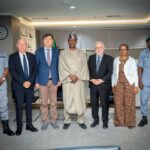
The Nigeria Customs Service has strengthened its commitment to coordinated border management and regional trade after a high-level benchmarking mission to the Beitbridge Border Post between Zimbabwe and South Africa. The mission was held to advance trade facilitation and economic integration in Africa.
The Comptroller-General of Nigeria Customs, Adewale Adeniyi, joined the Directors-General of Cameroon and Benin Customs, along with officials from Zimbabwe Revenue Authority and Bergmans Security Consultants. The exercise was supported by the African Export-Import Bank, Afreximbank, as part of efforts to deepen intra-African trade under AfCFTA.
Speaking at the adoption of the Joint Communiqué on Monday, 27 July 2026, CGC Adeniyi said the mission showed that border modernisation goes beyond infrastructure. He noted that sustainable reform depends on coordinated institutions, digital integration, accountability, and professional personnel to improve trade and security.
The five-day mission included technical sessions, facility tours, and briefings by Zimbabwean border agencies. The team was briefed on the Beitbridge Modernisation and Concession Model, covering financing, operations, revenue systems, and coordinated border governance. Participants also inspected cargo terminals, scanning systems, and ICT infrastructure.
According to the Joint Communiqué, the mission targets West and Central Africa trade routes. The Sèmè-Kraké corridor linking Nigeria and Benin, and the Mfum-Ekok corridor linking Nigeria and Cameroon, were identified as strategic routes to benefit from One-Stop Border Post arrangements and coordinated management.
Cameroon Customs DG, Fongod Nuvaga, said customs must work together to remove bottlenecks and strengthen regional cooperation to harness AfCFTA opportunities. Benin Customs DG, Colonel Raouf Aboudou, added that harmonised procedures and coordinated risk management are critical for seamless trade and better revenue assurance.
Director for Trade Facilitation at Afreximbank, Dr. Gainmore Zanamwe, said the goal was to expose African customs to governance models and operating systems behind successful border posts. He stressed that accountability, technology and service standards, not just infrastructure, drive performance.
The mission ended with Nigeria, Cameroon and Benin signing a Joint Communiqué. They agreed to set up a Trilateral Strategic Steering Committee to implement the recommendations. The three countries also pledged to pursue digital interoperability, harmonised procedures, coordinated risk management, and investment in staff development.