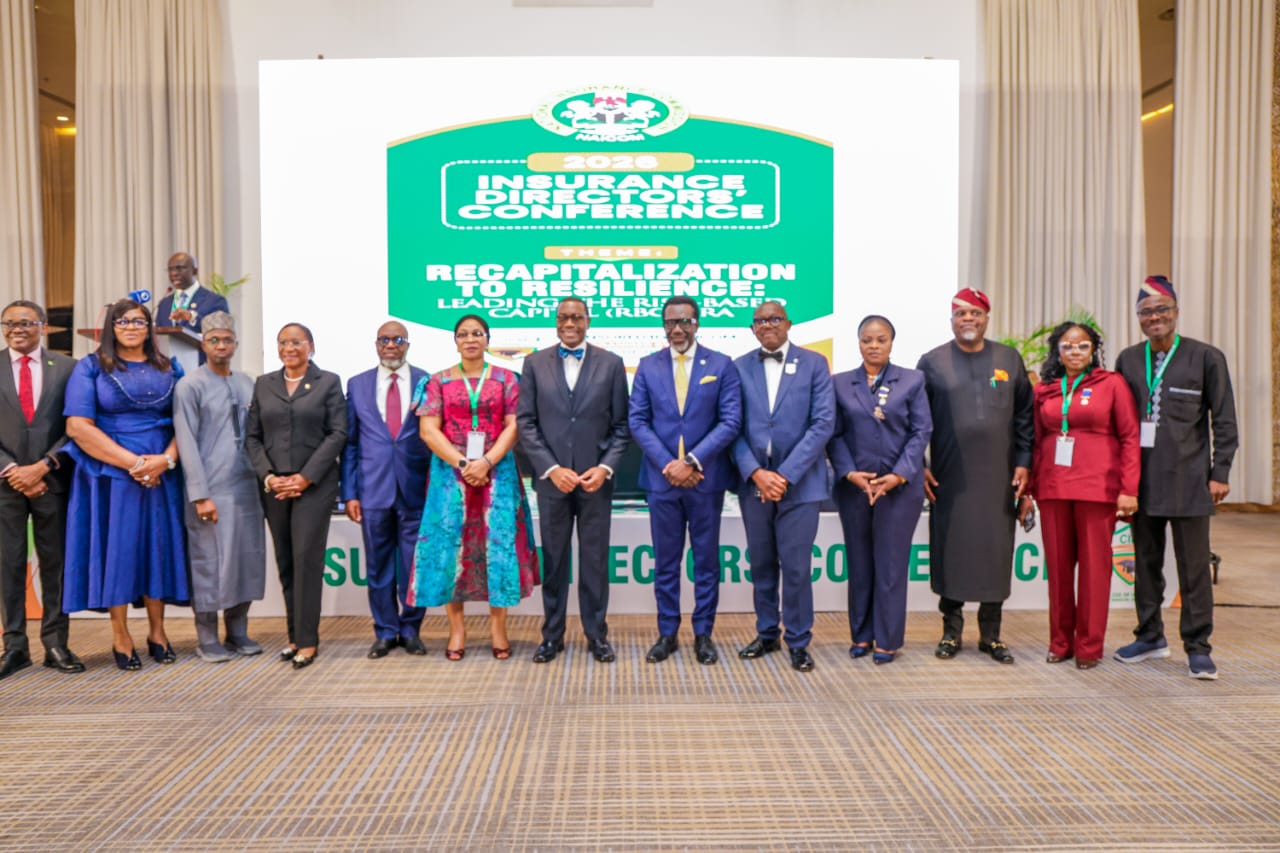
ABUJA, Nigeria’s Commissioner for Insurance, Olusegun Ayo Omosehin, on Thursday urged insurance directors to move beyond recapitalisation and build resilient institutions under the country’s new Risk-Based Capital regime.
Speaking at the 8th Annual Insurance Directors’ Conference, Omosehin said the industry had concluded its recapitalisation exercise but now faced a more demanding test — how capital is governed, protected and deployed.
“Recapitalisation was never the destination; it is the gateway to a more demanding phase,” Omosehin said.
PROTOCOLS
The Commissioner welcomed directors to the conference, organised by the College of Insurance and Financial Management in collaboration with the National Insurance Commission (NAICOM).
He commended shareholders, boards and management for the commitment and sacrifices that made recapitalisation possible, describing the exercise as laying a stronger foundation for the industry.
This year’s theme is “Recapitalisation to Resilience: Leading the Risk-Based Capital Era.”
FROM CAPITAL TO RESILIENCE
Omosehin said the critical question was no longer whether insurers had met prescribed capital requirements, but whether they could translate stronger capital into improved underwriting capacity, stronger risk management, better claims-paying ability and sustainable growth.
“A well-capitalised institution is not necessarily a resilient institution,” he said.
He warned that institutions with substantial resources could still fail due to poor governance, weak internal controls, ineffective risk management, inappropriate investments and inadequate board oversight.
True resilience, he said, is the ability to anticipate risks, absorb shocks, adapt to changing circumstances, recover from disruptions and continue delivering value.
GOVERNANCE IS THE REAL TEST
Omosehin placed particular emphasis on corporate governance, calling it one of the most important determinants of success in the post-recapitalisation era.
He said boards must move beyond receiving management reports to actively challenging strategy, interrogating assumptions and demanding sound judgement.
Boards, he said, must demonstrate stronger ownership of strategic leadership, capital stewardship, effective risk governance, management accountability, internal control and board composition.
“Board membership is not an honorary appointment. It is a position of trust,” he said.
SHAREHOLDERS, INDEPENDENCE AND ACCOUNTABILITY
Omosehin said shareholder expectations for returns and growth were legitimate but must be balanced against obligations to policyholders, creditors, employees, regulators and the public.
He said shareholder interests must not override prudential considerations, undermine board independence or encourage unsustainable strategies.
Boards must exercise independent judgement even when it conflicts with immediate shareholder expectations, he said.
A NEW PRUDENTIAL DISCIPLINE
The Commissioner explained the distinction between the Minimum Capital Requirement (MCR) and Risk-Based Capital (RBC).
MCR, he said, establishes the minimum capital threshold to undertake licensed business, while RBC considers the risks assumed by an institution and the capital required to support those risks.
“An institution may satisfy its minimum capital requirement but still have insufficient capital relative to the nature, scale and complexity of its risk exposures,” he said.
WHAT NAICOM EXPECTS
Omosehin said NAICOM’s supervision would increasingly emphasise quality of capital, adequacy of risk management, governance effectiveness, resilience and capacity to meet policyholder obligations.
He said institutions must demonstrate clear understanding of risk exposures and maintain systems for identifying, measuring, monitoring and managing them.
He also demanded greater emphasis on quality and reliability of regulatory returns, financial reporting, actuarial assessments and disclosures.
“Successful recapitalisation does not confer permanent immunity from regulatory scrutiny,” he said.
IMPLICATIONS FOR THE ECONOMY
Omosehin said a stronger insurance industry was better positioned to support national economic development, infrastructure, energy, manufacturing, agriculture and construction.
He said it could deepen domestic risk-retention capacity, reduce dependence on foreign insurance markets, become a more significant source of long-term investment, deepen penetration and support financial inclusion.
He challenged insurers to translate stronger capital into greater economic relevance and prompt, fair claims settlement.
“The public does not measure the strength of an insurance company by the size of its capital alone,” he said.
FIT AND PROPER
On governance, Omosehin said Fit and Proper requirements were far more than a regulatory requirement.
He said appointments to boards and senior management must be driven by competence, character, capability and commitment — not status, familiarity, influence or relationships.
A CALL TO LEADERSHIP
Omosehin closed by asking directors whether their institutions were genuinely stronger or had merely satisfied a regulatory threshold.
He asked whether boards were equipped to challenge risks, whether capital was being deployed prudently, and how increased capital would translate into better underwriting, better claims settlement and stronger policyholder confidence.
“You are not merely directors of insurance companies. You are custodians of policyholders’ trust,” he said.
He said the post-recapitalisation era should be remembered not merely as a period when insurers raised more capital, but as the period when the industry fundamentally transformed its governance and became more relevant to national development.


Abuja’s number one hit music and talk radio station. Broadcasting 24/7 on 99.9FM across the Federal Capital Territory and streaming live worldwide.
© KissFM 99.9 All rights reserved.