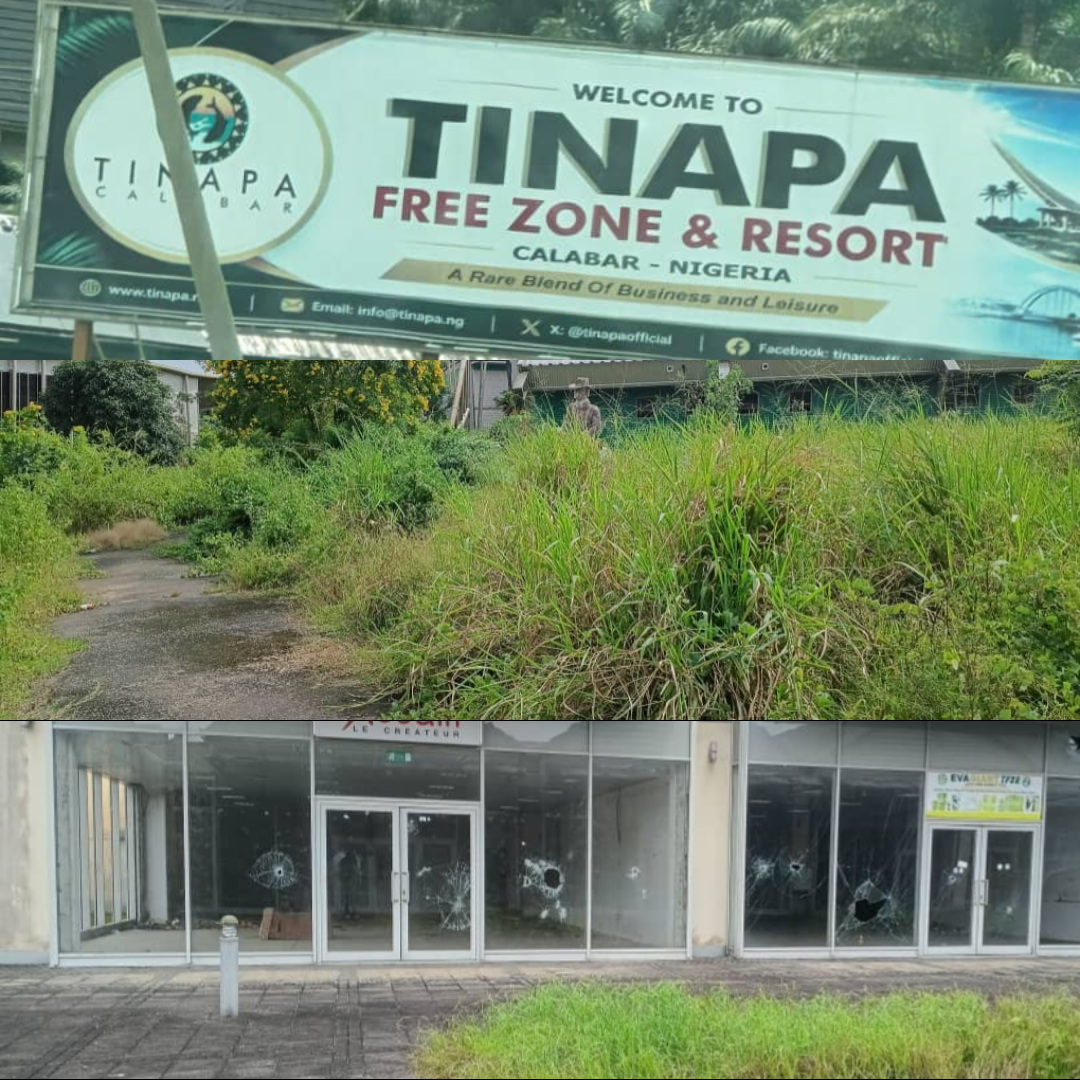
Six years after EndSARS looters stripped Nigeria’s biggest resort, NEPZA says culprits should be prosecuted as Cross River moves to reclaim its Dubai dream.
Inside Calabar, there is another city.
It sits on 265 hectares of thick green forest. It has shopping malls as big as two football fields, a 242-room hotel, a film studio, conference halls, lakes and roads wide enough for a metropolis. It was supposed to be Nigeria’s Dubai — where Nigerians would shop, relax, heal and do business without a visa.
That city is Tinapa Business and Leisure Resort. For more than a decade, it has been a ghost city. Shops locked. Hotel empty. Lights off.
Now, its lights are flickering back on.
”It is the most resilient project in Nigeria,” says its General Manager, Dr Francis Ekom. “It has survived things that have killed other projects.”
The Radical Dream
Tinapa was the brainchild of former Cross River Governor, Donald Duke.
At the time, the idea was strange. Free trade zones in Nigeria meant one thing: factories. Textiles, machines, heavy manufacturing to earn dollars.
Cross River said no. Give us 265 hectares for shopping, tourism, leisure and entertainment.
”It was an affront to the status quo,” Ekom recalls. “Free zones were seen as manufacturing enclaves. We proposed retail and leisure. People wondered, how will that work?”
Because it was new, the rules had to be written from scratch. How would goods enter? How would they exit? What would Customs collect? All that was supposed to be in a gazette — the legal document that gives a policy the force of law.
Before President Olusegun Obasanjo left office in 2007, he issued an executive order approving Tinapa. The government thought that was enough. It was not.
Two Years That Cost Everything
After Obasanjo left, the Nigeria Customs Service said without a gazette, Tinapa could not operate as a free zone.
So from April 2, 2007, when it was commissioned, until 2009, Tinapa sat idle. Locked. Silent.
Those two years were expensive.
In 2008, the world crashed into a global financial meltdown. Banks failed. Multinationals that had promised to make Tinapa their African headquarters pulled back to survive.
”We lost our voice,” Ekom says. “We had created massive awareness before commissioning, but with no operations, we had nothing to say. When the gazette finally came under President Umaru Yar’Adua, two years had lapsed. We had lost many anchor tenants.”
Still, from 2009, Tinapa crawled back. State governments held retreats there. Professional bodies held conferences. The famous T-Mart saw shoppers. Over a million visitors came in months at its peak.
But progress was stop-start. Ekom counts four major disruptions — three were policy and economic shocks. The fourth nearly buried Tinapa.
The Night Looters Came
During a media tour of Tinapa organised by the Nigeria Export Processing Zones Authority (NEPZA), under the leadership of its Managing Director, Dr Olufemi Ogunyemi, journalists were shown the ruins — gutted malls, vandalised hotel rooms and an abandoned light rail.
October 2020. Nigeria was on fire with the EndSARS protests against police brutality.
The Tinapa tour guide, Engineer Umoh Udoh, lamented with pain:
”In Calabar, the mob did not go to government warehouses alone. They went to Tinapa.
”No other place in Nigeria suffered what we suffered,” Udoh says. “Tinapa was the worst impacted nationwide.”
They carted away beds, televisions, air conditioners, computers, tiles, doors, even cables from the walls. What they could not carry, they smashed.
The 242-room hotel, the biggest in Cross River, was stripped naked. A complex that employed over 6,000 people during construction became a skeleton.
Today, walking through Tinapa, you still see burnt walls and empty halls, but you also see fresh paint, air-conditioned offices and new banners.
”The fact that you are not sitting in a forest but in an air-conditioned room shows resilience,” Udoh tells visiting journalists.
Why Tinapa Refuses To Die
Why keep a “dead” project alive?
Ekom’s answer is simple: The reasons Tinapa was built are still alive and even more urgent.
”Do we still need jobs for our youth? Yes. Do we still need to conserve forex? Yes. Only 5% of Nigerians can afford to travel abroad for shopping, hospital and leisure. Can we bring those companies here? Yes,” he says.
The original plan by KPMG was phased , start with retail, then move to visual entertainment, health, hospitality and technology. That plan still holds.
And for once, Ekom says, Cross River has a governor who is not abandoning his predecessor’s project.
Governor Bassey Otu, who is from Tinapa’s host community, made two big moves.
First, ownership. For years, it was unclear , was Tinapa federal or state? Debts piled up and ended with AMCON. No investor touches a property with disputed owners.


Abuja’s number one hit music and talk radio station. Broadcasting 24/7 on 99.9FM across the Federal Capital Territory and streaming live worldwide.
© KissFM 99.9 All rights reserved.